
Green bathroom: calm that never goes out of fashion
A green bathroom is a room of calm — if the shade, the tiles and the light work together. Sage, forest green, tile options and lighting in one guide.
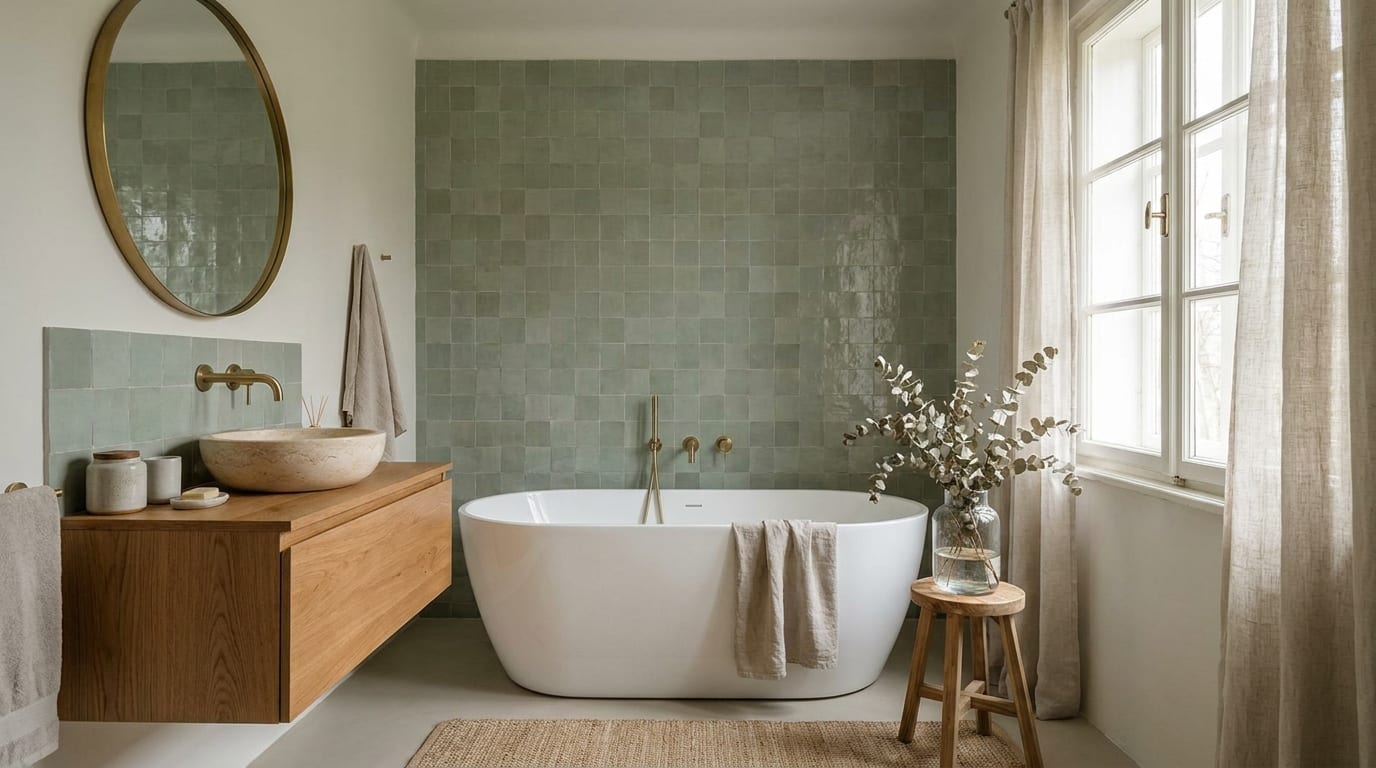
The bathroom is the only room where the day genuinely begins and ends — and yet for decades we treated it as a sterile, white wet room. Green is precisely what overrides that habit: the colour of nature on the tiles and on the wall says that this is not a utility room but the calmest point in the home.
A green bathroom is, however, a more demanding genre than a green kitchen: the room is smaller, there is less natural light, and the colour of the tile is a final decision. This guide goes through how green becomes calm — and not a swimming-pool atmosphere.
Key points
- In a small, windowless bathroom the light, greyish greens work; deep forest green belongs in a large room or one with good light.
- Green tiles need a warm counterpoint: timber furniture, brass or travertine — all green and the room stays cold.
- The colour of the light is even more critical here than elsewhere: under cool white light every green turns chlorinated.
- You do not have to go as far as tiling: a painted green wall in the dry zone is the cheapest and most easily reversible route.
Which green belongs in a bathroom?
The bathroom is typically the smallest room in the home and the one with the least light — that, and not your favourite colour, is the starting point when choosing a shade.
| Shade | When it works | What to watch |
|---|---|---|
| Sage green | A small, windowless bathroom — the safest choice | It turns grey under cool light: warm light is essential |
| Eucalyptus, grey-green | Modern, light spaces; it takes diffused light well | Lifeless alongside too much grey |
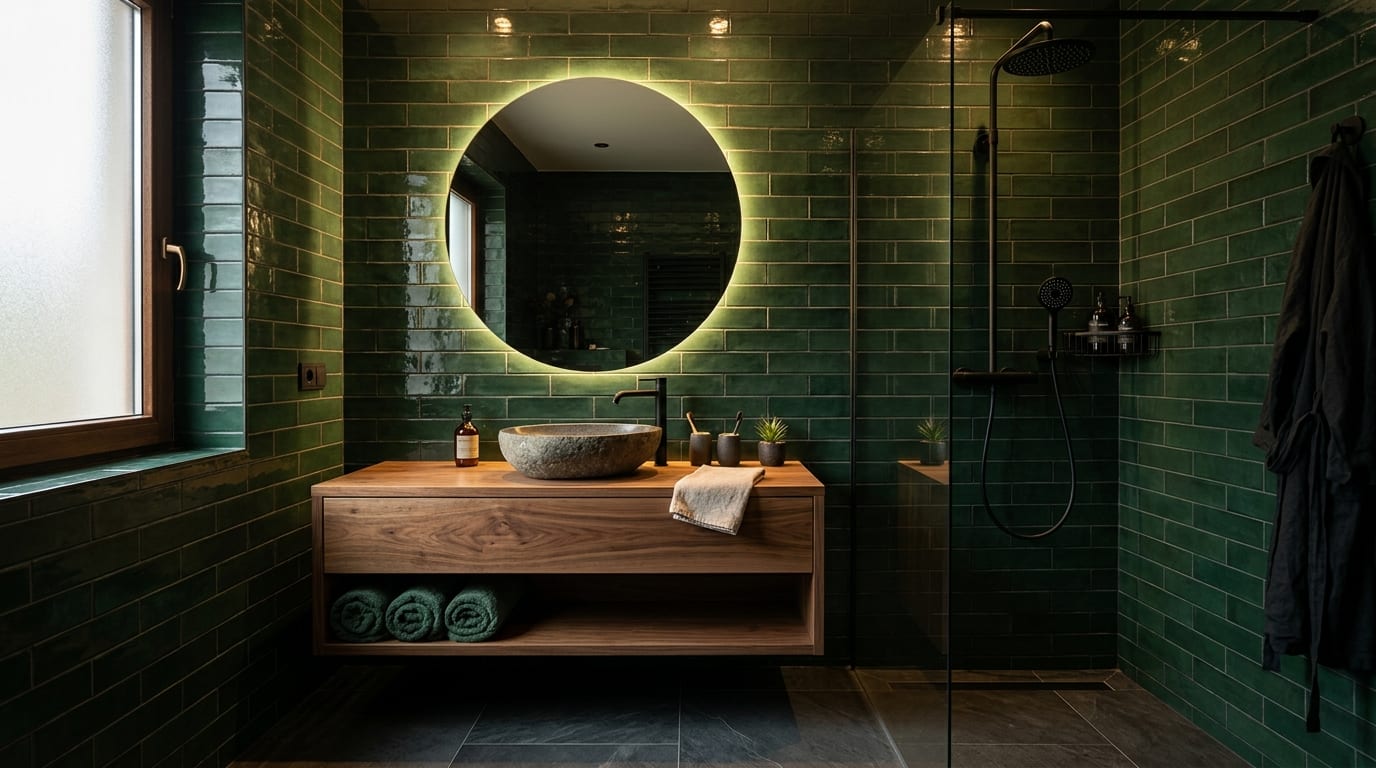
| Forest green, bottle green | A large bathroom or one with a window; as an accent wall in a smaller one | Over the full wall area in a small space it creates a cave effect |
| Mint green | If you specifically want a fresh, light effect | It slides easily into swimming-pool aesthetics — a warm timber counterweight is needed |
Tiles, paint or microcement?
There are three routes to green, and it makes a difference which one you set out on.
Tiles are the most durable and the most final. Small-format green tiles with a handmade feel (metro, herringbone, zellige-type) give a living surface with depth, because every piece is slightly different — a large-format green tile, by contrast, quickly looks like a museum. The grout colour is decisive: grout that blends with the green gives a calm surface, while a contrasting white draws a grid.
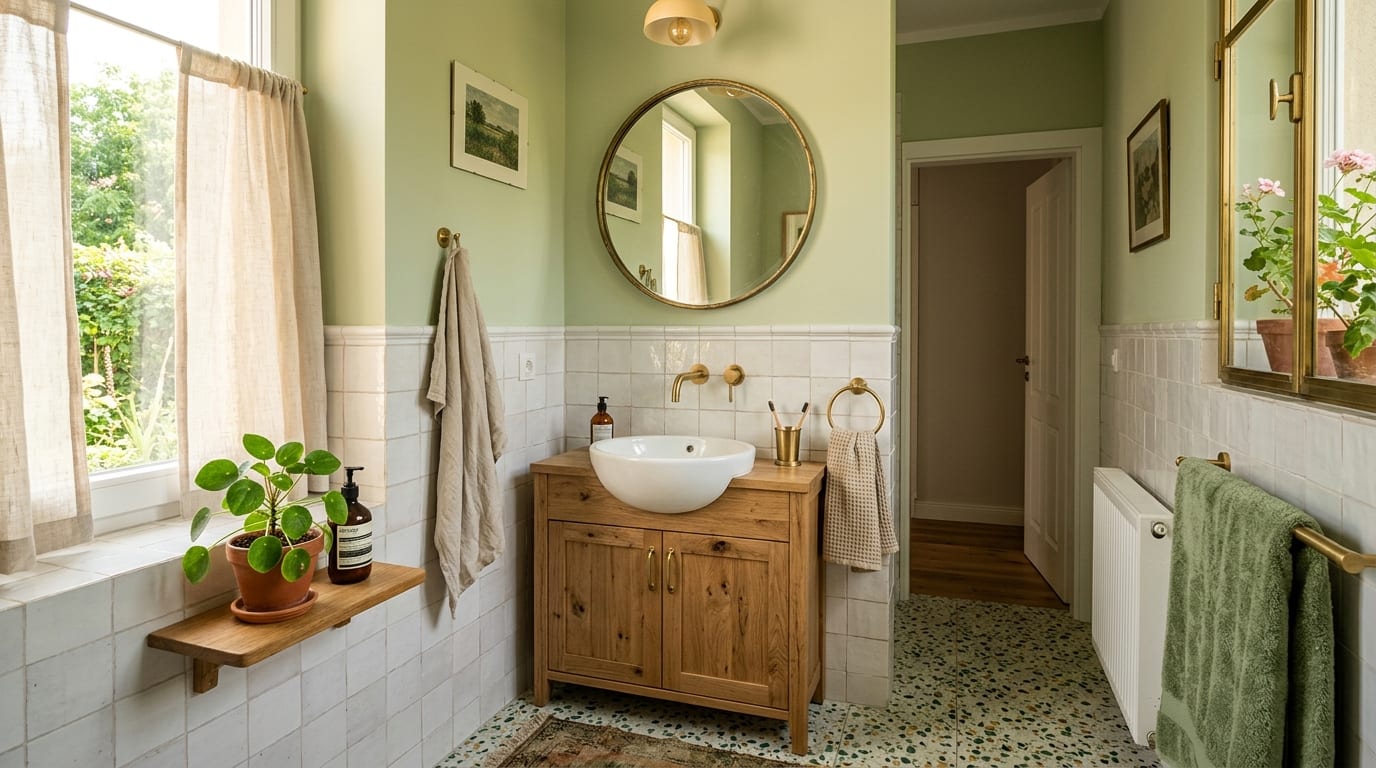
Paint is entirely legitimate in the dry zone — above the WC, on the wall beside the basin, in the non-splash band above the bath — and it can be reversed at any time. Choose a moisture-resistant, washable paint.
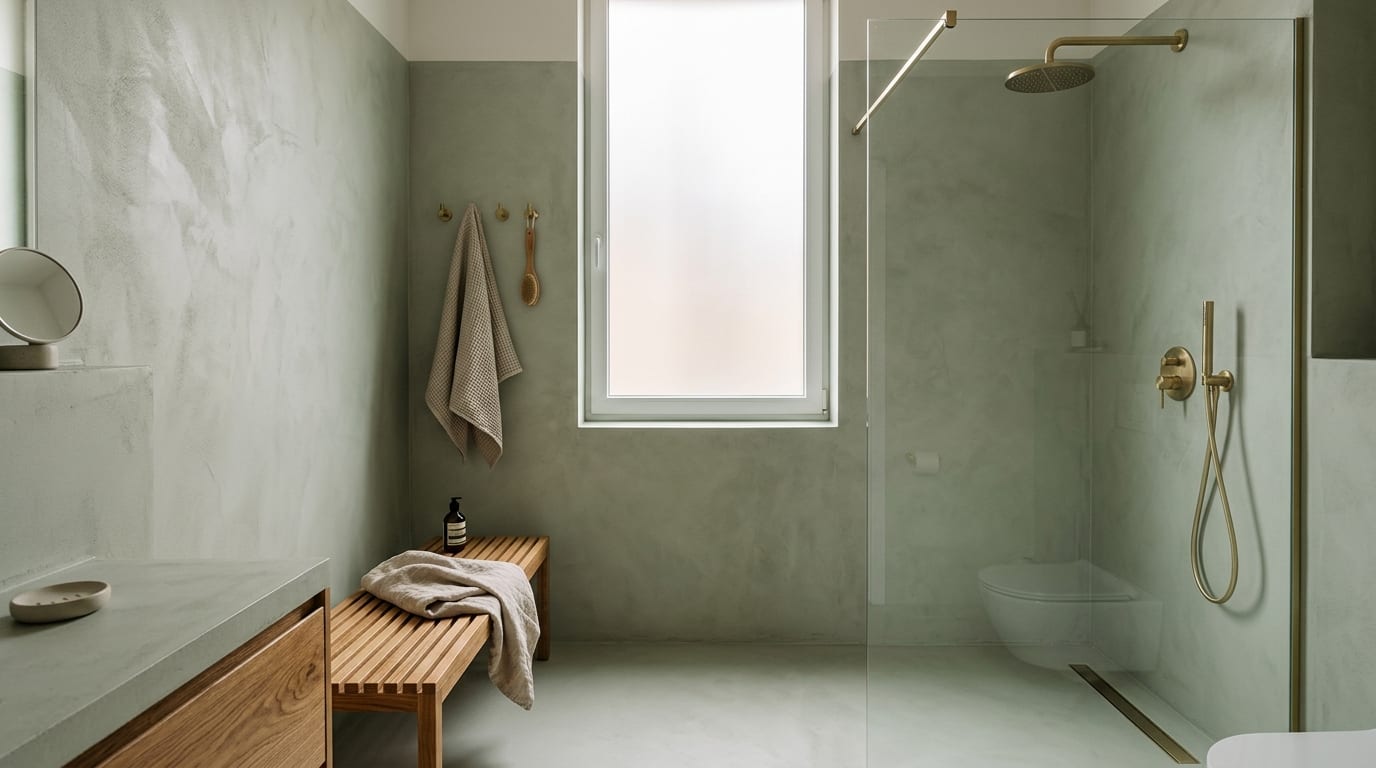
Microcement gives a grout-free, continuous green surface in the shower as well — it suits modern spaces, but it is a genre that is sensitive to the installer: here everything really does rest on the tradesman.
The counterpoint: timber, brass, stone
Green on its own makes for a cold room — particularly on tile, which is a cool material to begin with. The recipe is the same as in the green kitchen: green needs one warm and one mineral material alongside it.
- A timber vanity or cabinet: the one element that makes a green bathroom immediately homely. In a wet room, oak or teak with an appropriate surface treatment.
- Brass or bronze fittings: tap, shower set, mirror frame — green’s best friends. Chrome belongs with the cooler greens.
- Travertine, limestone or terrazzo: a soft, warm mineral layer alongside the green, on the floor or on the vanity top.
Light: this is where it is decided what green you get
The light in a bathroom counts twice: in the morning you need functional light at the mirror, in the evening something calming at the bath. With green, both have to be warm — 2700–3000 K, with high colour rendering (CRI 90+). Cool white at 4000 K turns green tiles chlorinated and the skin sallow.
At the mirror the light should come from both sides, not from above — light from above casts shadows on the face. Where it is possible, a concealed layer of light running low down (LED under the vanity or at plinth level) gives the room an evening mode: it is exactly enough for a bath, and the green is at its deepest then. Our lighting design article covers the logic of the layers.
Green in the rest of the home
A green bathroom rarely stands alone: the colour turns up somewhere else in the home as well — and that is as it should be. If the same tonal family returns in the textiles of the bedroom, in a plant or an armchair in the living room, the home reads as a whole.
Practicalities: dimensions and splash zones
Alongside the choice of colour, a bathroom stands or falls on its dimensions — on the 100×70 centimetre clear band in front of the basin, on the internal dimensions of the shower, on the direction the doors open. We have collected these in our bathroom ergonomics guide; those are the fundamentals whatever the colour.
From the point of view of green there is one rule about dimensions: the boundary of the tiled zone should be a deliberate decision. The classic solution — tiles up to 120 centimetres, paint above — is particularly attractive with green: a lighter painted wall above a band of deeper green tile also lifts the space.
Five mistakes in green bathrooms
- The same green from floor to ceiling in a small room — it becomes a cave, not a retreat.
- A cool white light source. It turns every green into a swimming pool.
- White, contrasting grout on a surface intended to be calm — it draws a grid on the wall.
- Nothing but cold materials: green tile plus chrome plus white sanitaryware, with no timber. It stays sterile.
- A fashionable green on a permanent surface. A neon, greyish or very on-trend shade on tile is a commitment of decades — the safe deep and dusty greens age better.
Should we dare to go green?
Yes — but the order is sacred here too: first the light and the givens of the room, then the shade, and finally the material pairing. If you are uncertain, start with a painted wall and timber furniture: that alone gives you the calm of a green bathroom, and you close nothing off permanently. Go as far as tiling once you have seen the shade in real life, in the light of your own bathroom.