
Bathroom tiles: large format or small?
Bathroom tile ideas through a designer’s eyes: how much grout falls on a square metre, what each tile size does to the room, and when the large format fails.
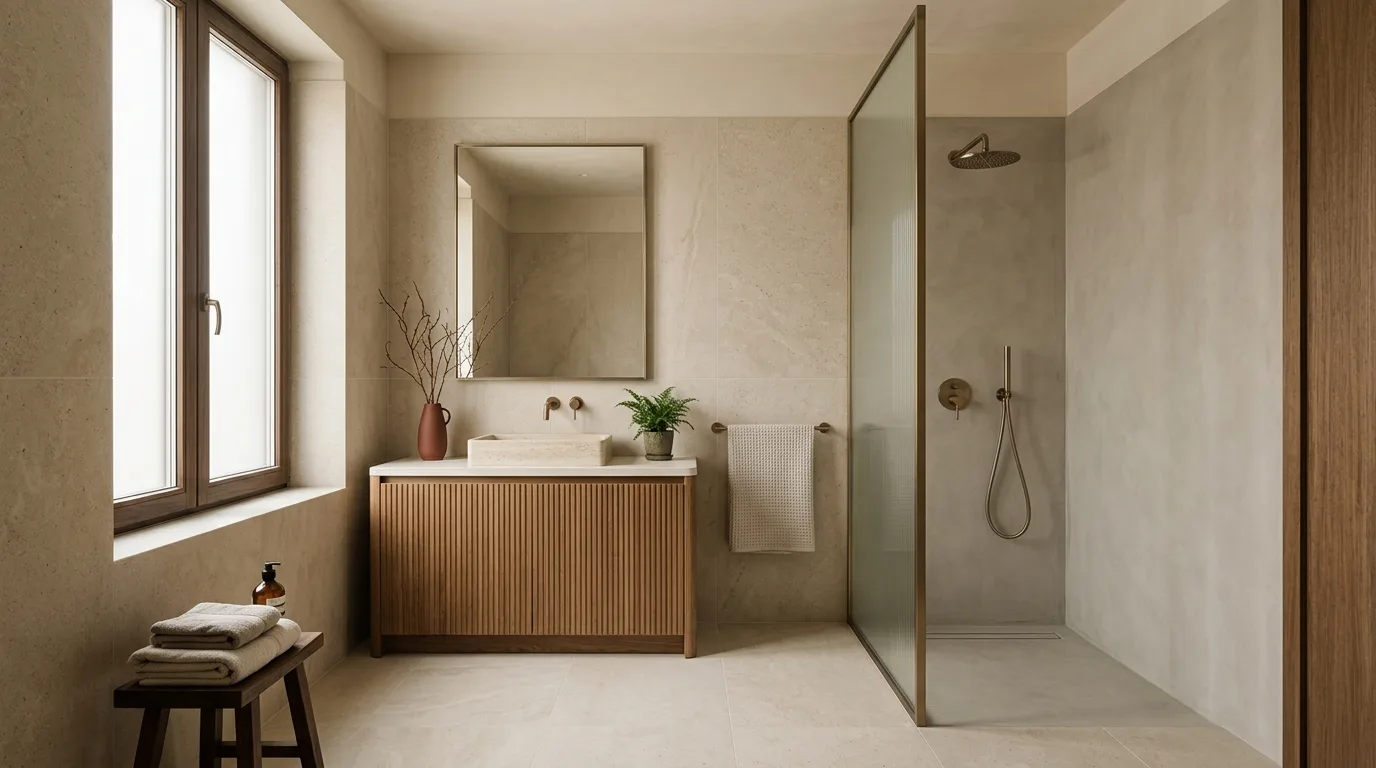
When choosing bathroom tiles, everyone looks at the pattern. Yet the feel of a room is not decided by the pattern but by something far more prosaic: how many linear metres of grout there are per square metre.
At a glance
| What it decides | The feel of the room, how easy it is to clean, and the cost of the work |
| The key number | Linear metres of grout per m² — see the drawing |
| The advantage of large format | Little grout, a continuous surface, easy cleaning |
| The disadvantage of large format | It needs a flat substrate, it takes two people to lay, and cutting costs more |
| What you must never leave to the tiler | The setting-out and the grout colour |
The drawing that says it all
Between ten metres of grout and one metre there is no aesthetic difference. The eye works out the size of a room from its edges.
What tile size does to a room
20 × 20 — a mosaic-like rhythm. Ten linear metres of grout per square metre. On a small area — the floor of a shower enclosure, a niche — it is good, because it gives texture. On a large wall it is restless.
30 × 60 — the Hungarian default. Five metres of grout. This is the most widespread size, and for exactly that reason the least memorable. Neither texture nor a continuous surface.
60 × 120 — the point where the surface comes together. Two and a half metres of grout. This is the size at which tiling starts to look like a wall rather than tiling. In return it needs a flat substrate: on a 120 tile, 2 mm of unevenness already shows.
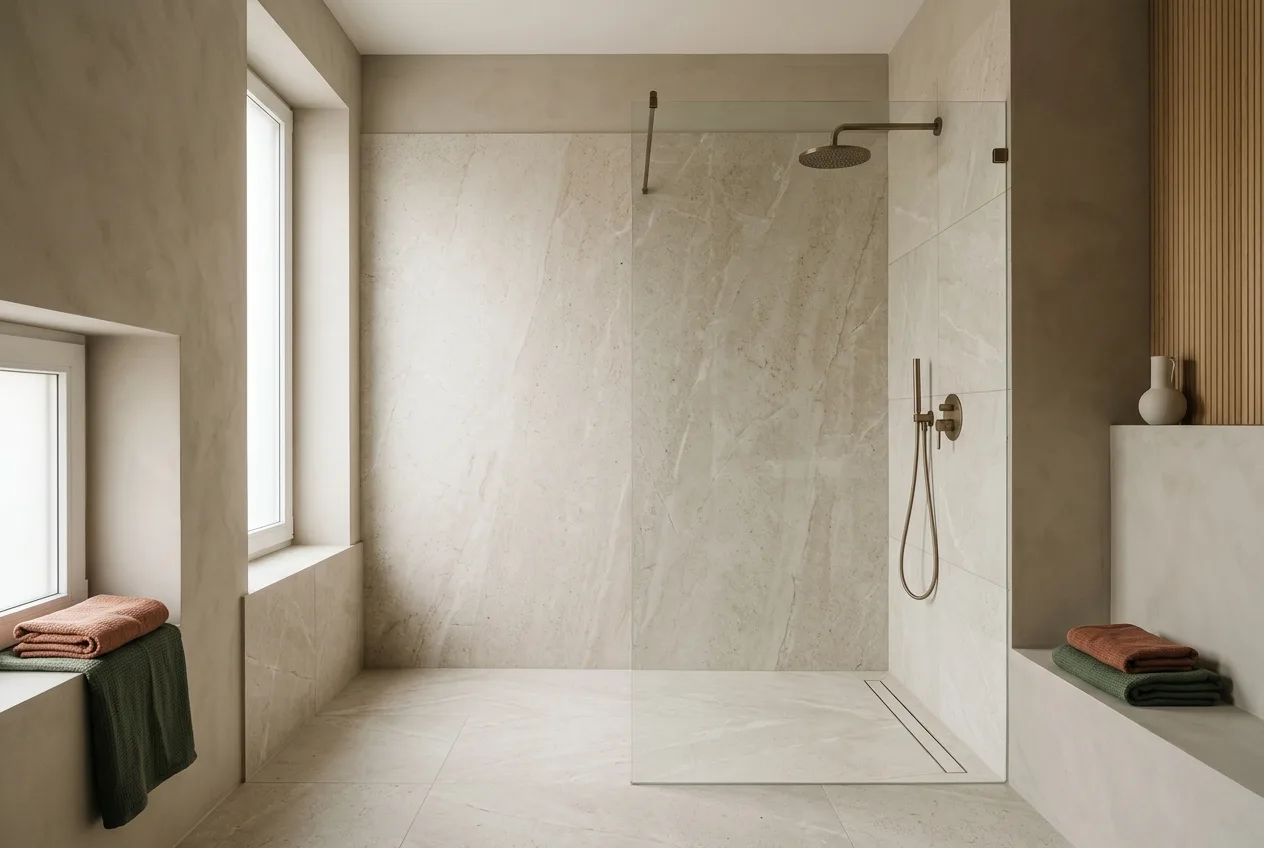
120 × 280 — almost grout-free. Barely more than a metre. An average bathroom wall comes out of a single slab. Expensive, heavy, laid by two people — but the effect is incomparable.
Where the large format fails
On an uneven substrate. The bigger the slab, the less it tolerates a wavy wall. Levelling the wall ahead of large-format tiling is not optional, it is a separate trade — and a separate cost.
With poor cutting. Cutting a socket or a tap penetration into a 120 × 280 slab is only possible with a waterjet. If the contractor tries it with an angle grinder, the slab will crack.
In a small, broken-up bathroom. If the wall is shorter than two metres and full of corners, niches and doors, a large slab will end up as offcuts anyway — and its advantage is lost. Here 60 × 120 is the sensible limit.
Where the floor falls. In a shower the fall means a large slab has to be cut on edge. There a smaller format is better — or, if you really do want a grout-free surface, microcement.
The grout nobody plans
There are two decisions, and both have to be made in the design, not on site:
Grout colour. Light grout on a dark tile draws a grid of lines onto the wall — precisely what we wanted to avoid. The grout should match the tone of the tile or be half a shade darker. It is the one decision that costs nothing and changes the most.
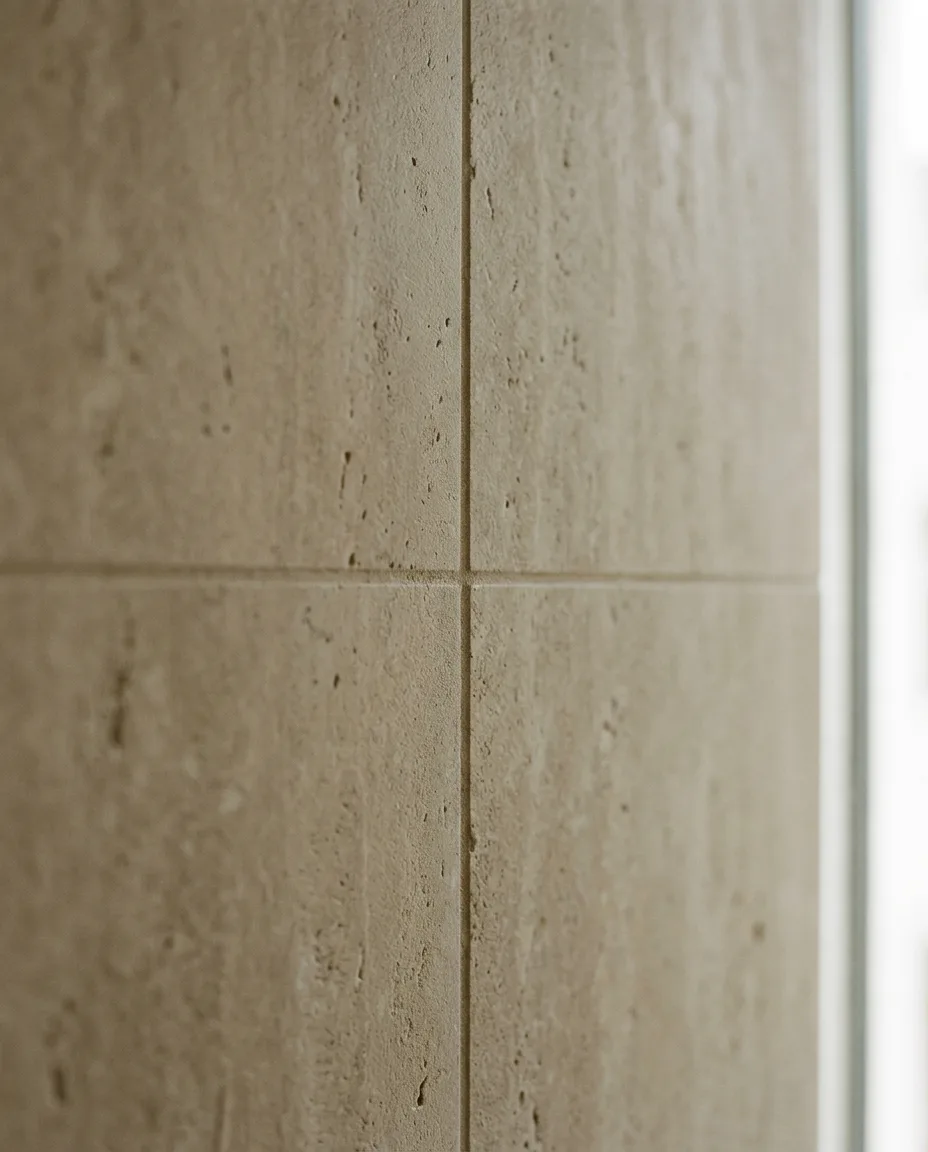
Grout width. 1.5–2 mm for large formats, 2–3 mm for smaller ones. Only ask for anything wider if the edges of the tile are not rectified.
Setting out: the half day that decides everything
Setting out means drawing up in advance which slab goes where, where the cuts fall and where the grout lines land. It is half a day of design work, and it solves three things:
- No slivers. Neither end of the wall should finish with an 8 cm stub — we put the cut in the less visible corner.
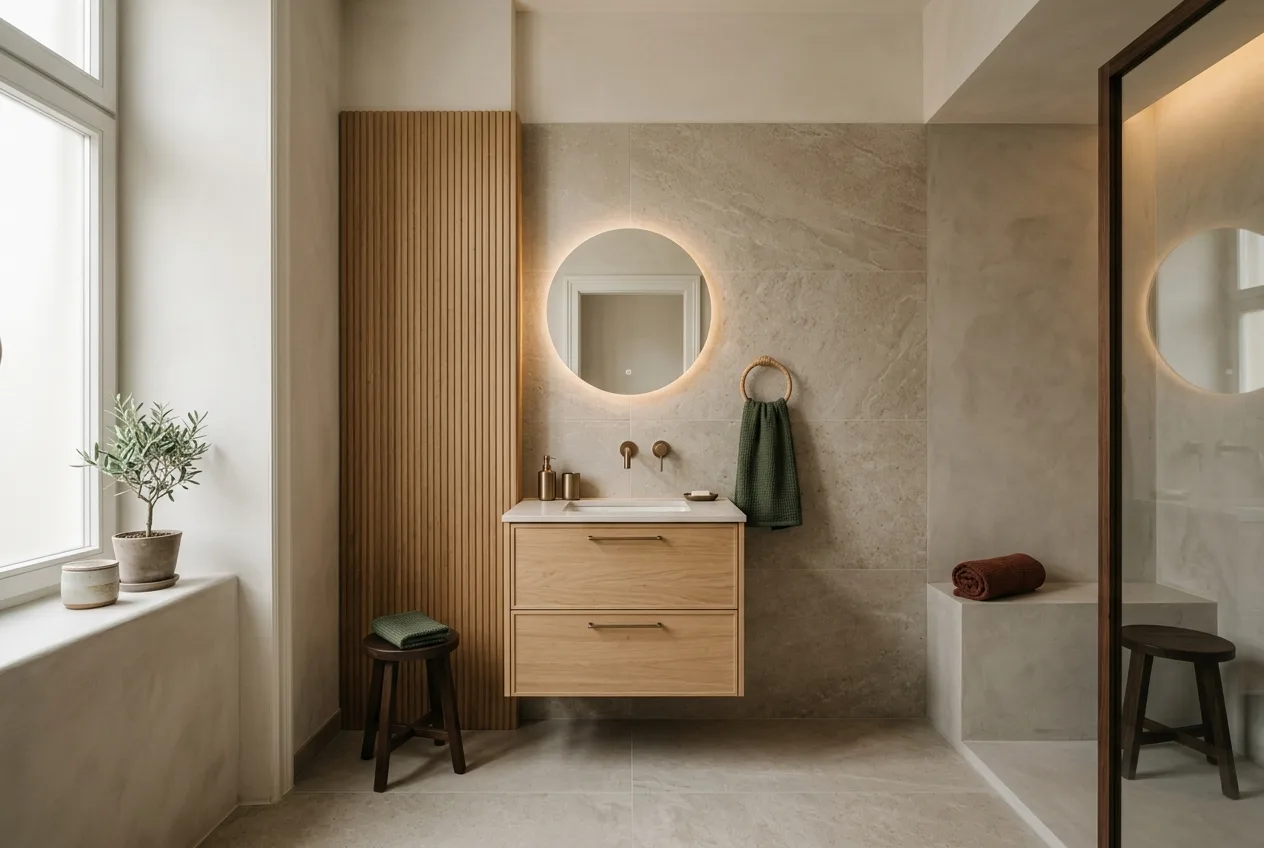
- The grout does not cut across the basin. The grout line should not run exactly through the middle of the tap or the mirror.
- The floor and wall grout lines meet. This is the detail nobody can name but everybody feels.
That is why, in full design documentation, the tile setting-out has a sheet of its own.
Frequently asked questions
Which tiles suit a small bathroom?
The largest that still fits the wall in one piece — typically 60 × 120. In a small space, few grout lines open it up more than any light colour. The same tile in the same tone on both floor and wall strengthens the effect further.
Does it have to be tiled up to the ceiling?
In the shower, yes. Elsewhere it is not compulsory, but if it stops at half height, the horizontal line of the finish cuts the wall in two and makes the room look lower. If you have to save, let the tile be cheaper on the wall you cannot see rather than let the tiling stop lower.
Can the same tile go on the floor and on the wall?
Yes, if the version intended for the floor is anti-slip (R10 or R11). Most manufacturers offer the same decor with two surfaces — ask about it before ordering.
How much more expensive is the large format?
The material price is typically 30–60% higher and the laying 50–100% more — but less grouting and less cleaning come with it. If the whole bathroom is large format, budget for levelling the walls as well.
If this sounds familiar — that you have chosen the tile but do not know what size to use — see how we work.
Next read: Travertine: the stone that brings quiet into any room