
Travertine: the stone that brings quiet into any room
Travertine through an interior architect’s eyes: filled or unfilled, where it works and where it fails, and how to detail the edges. A guide to choosing stone.
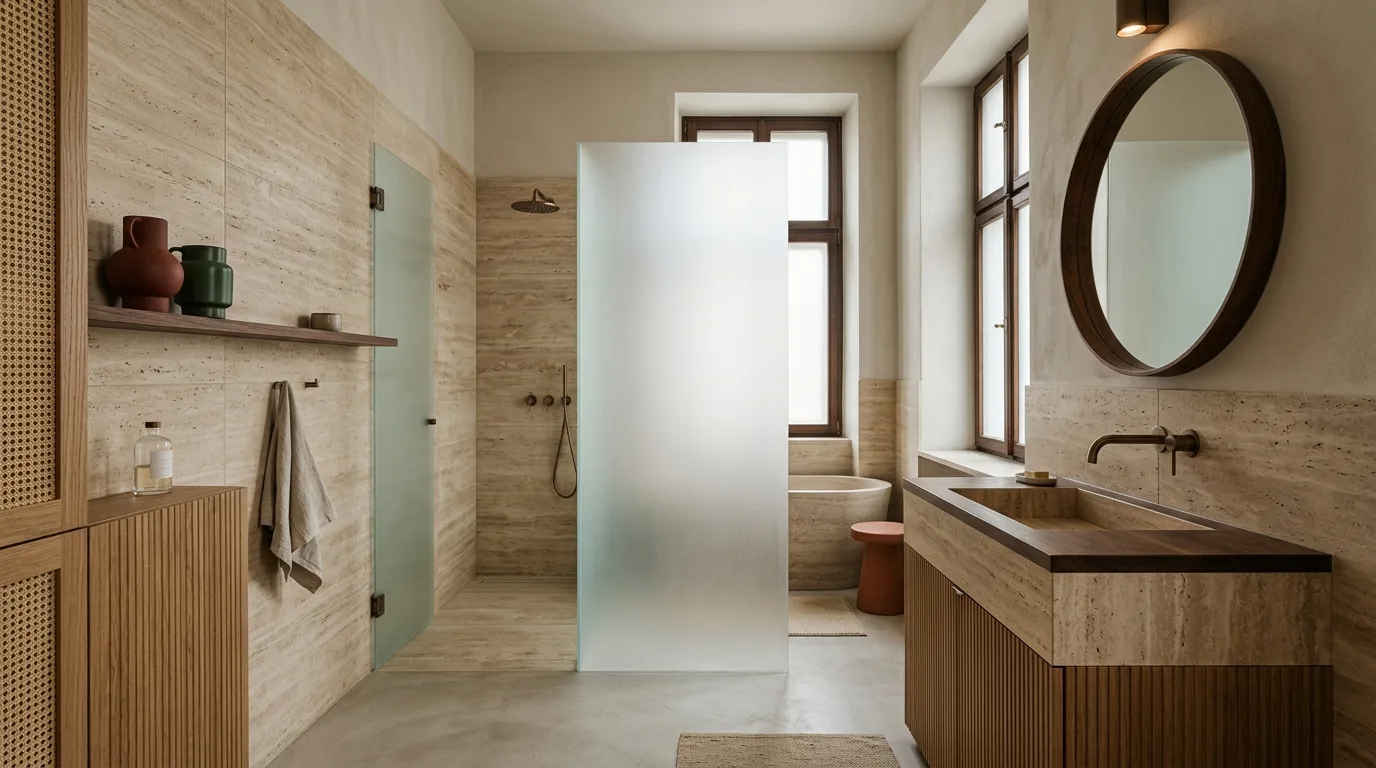
Travertine is not uniform, and that is exactly why it settles the eye. There is something to look at, but no pattern that has to be followed — so the gaze lingers on it without having to work.
At a glance
| Where it works | Large surfaces: a bathroom wall, a fireplace wall, a washstand top, a staircase |
| Where it does not | In small patches, as decoration; as a worktop exposed to strong acids |
| Price bracket | High — but the spread is wide, depending on the quarry and the direction of cut |
| Contractor demands | Medium. Stone is more forgiving than microcement |
| Patina | With travertine it is not a fault but an asset |
Filled or unfilled?
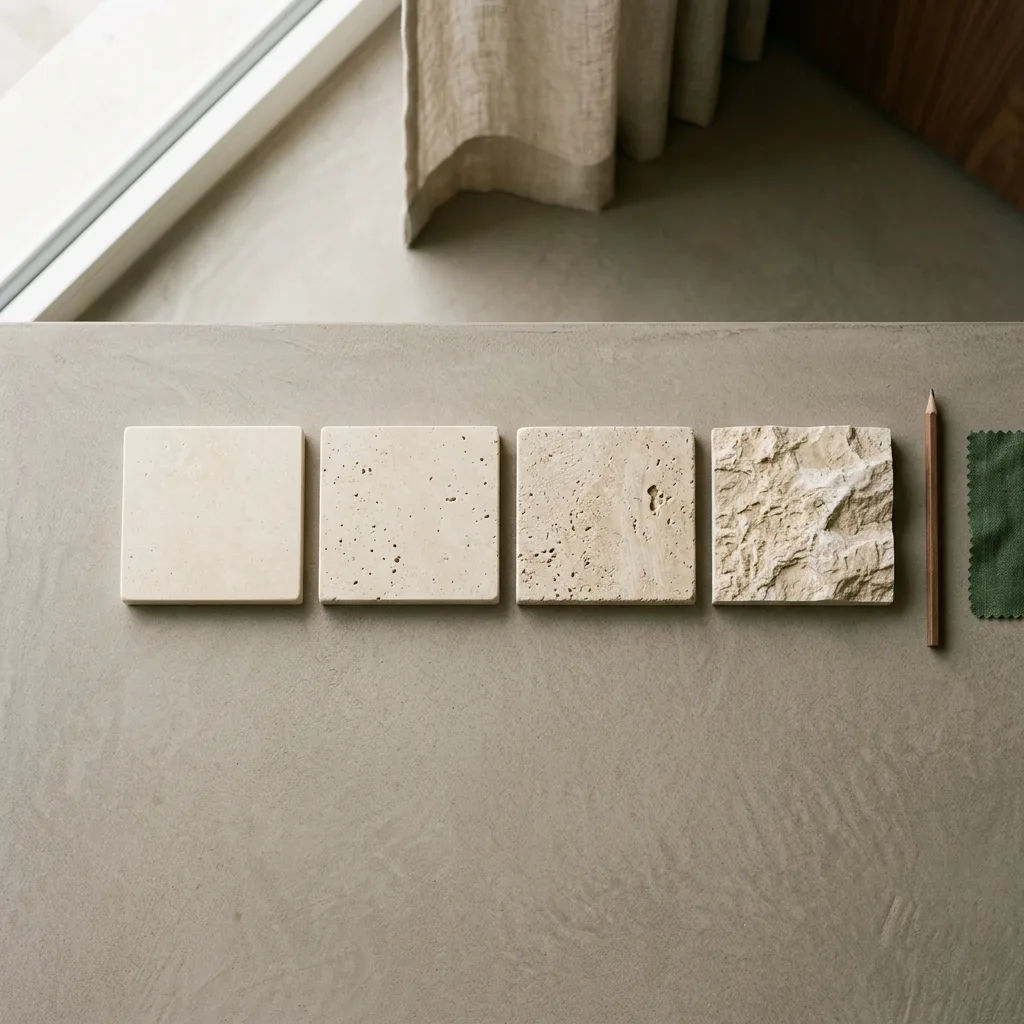
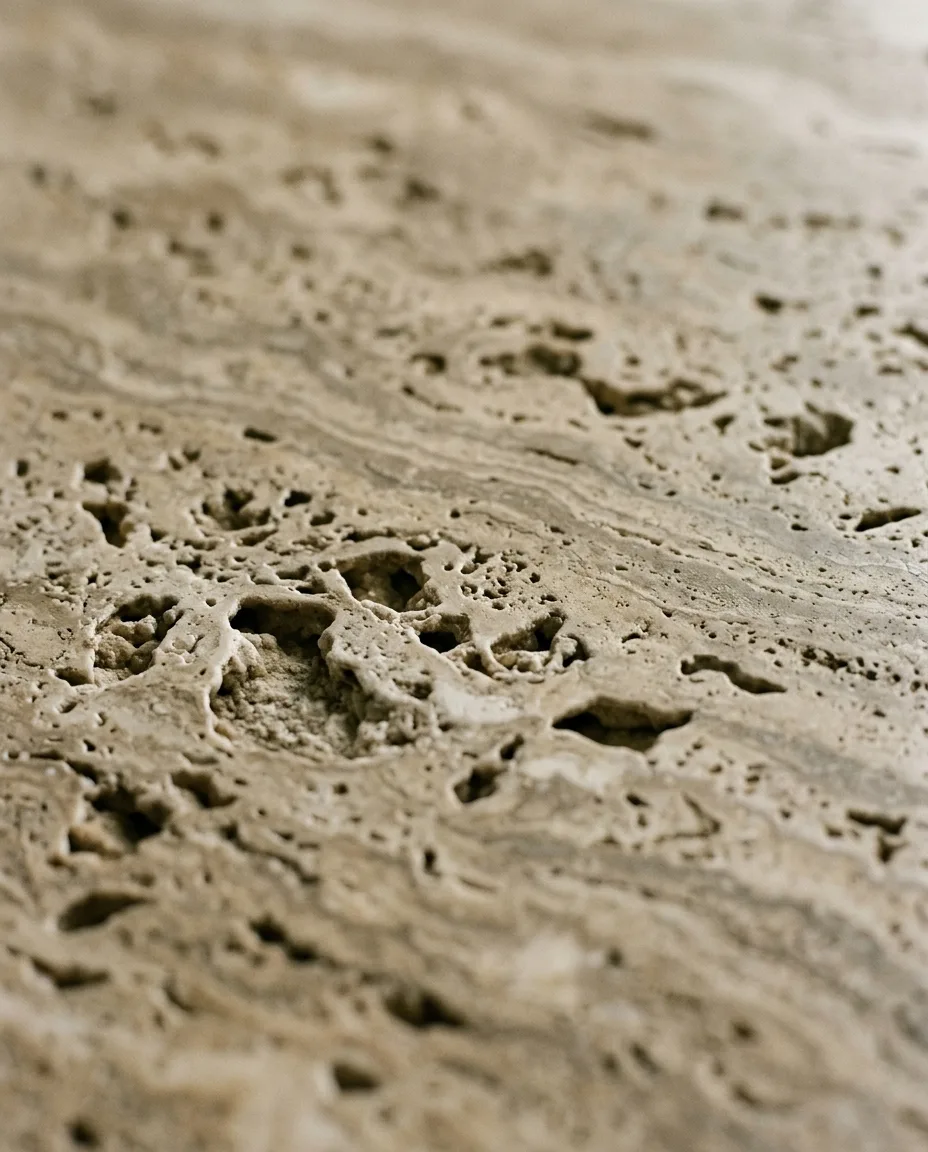
This is the one decision that genuinely matters. The natural pores of travertine — the former bubbles left in the stone — are either left open or filled with resin.
Unfilled: more beautiful, more alive, deeper. Light falls into the pores and the surface looks three-dimensional. In return it collects dust, and in a wet room it asks for regular impregnation.
Filled and honed: smooth, cleanable, predictable. This is the one that survives a family bathroom.
The practice we tend to follow: filled in wet rooms, unfilled in dry ones. On a living-room fireplace wall, leave the pores open — behind the shower, do not.
Where it works
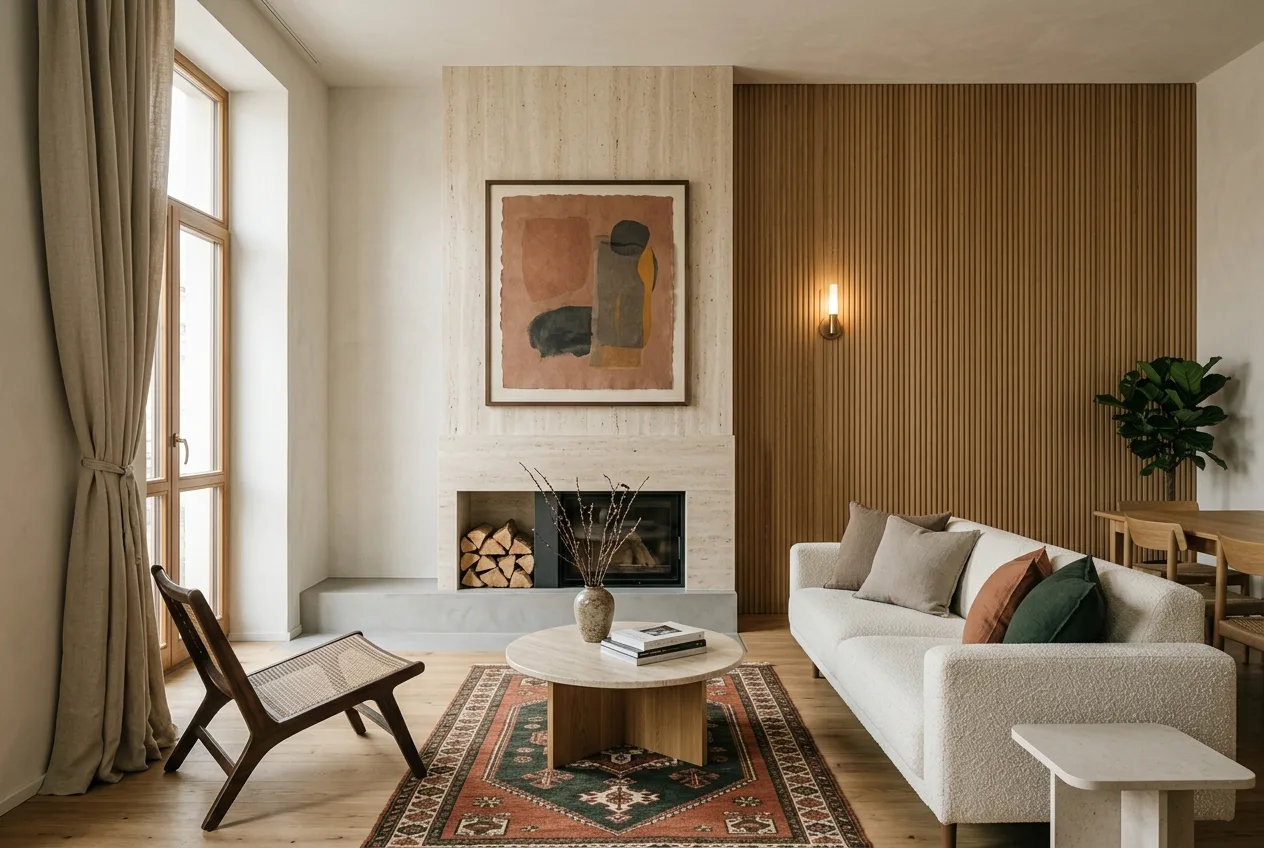
On a large continuous surface. Travertine shows well when it has room to unfold: a whole bathroom wall, a fireplace lining running from floor to ceiling, a staircase. In small, mosaic-like patches it loses its character.
Next to timber. Travertine is a warm greyish beige. It works with walnut and oak because it has the same temperature — not because both happen to be natural materials. In many cases this distinction decides whether a space will be calm or muddled. There is more on this in our article on colour and building a colour palette.
With bronze and brass. Cold chrome clashes with it. Warm metals finish it.
Where it fails
On a worktop exposed to acids. Travertine is a limestone: lemon, vinegar and red wine etch it. We do not recommend it as a kitchen worktop — there, quartz composite or ceramic is the right decision.
With poor setting-out. The figure of natural stone varies from quarry to quarry, and even from block to block. If the tiler works straight out of the box in order, the result will be blotchy. The slabs have to be laid out on the floor in advance and the sequence chosen deliberately — that is half a day of work, and the whole wall depends on it.
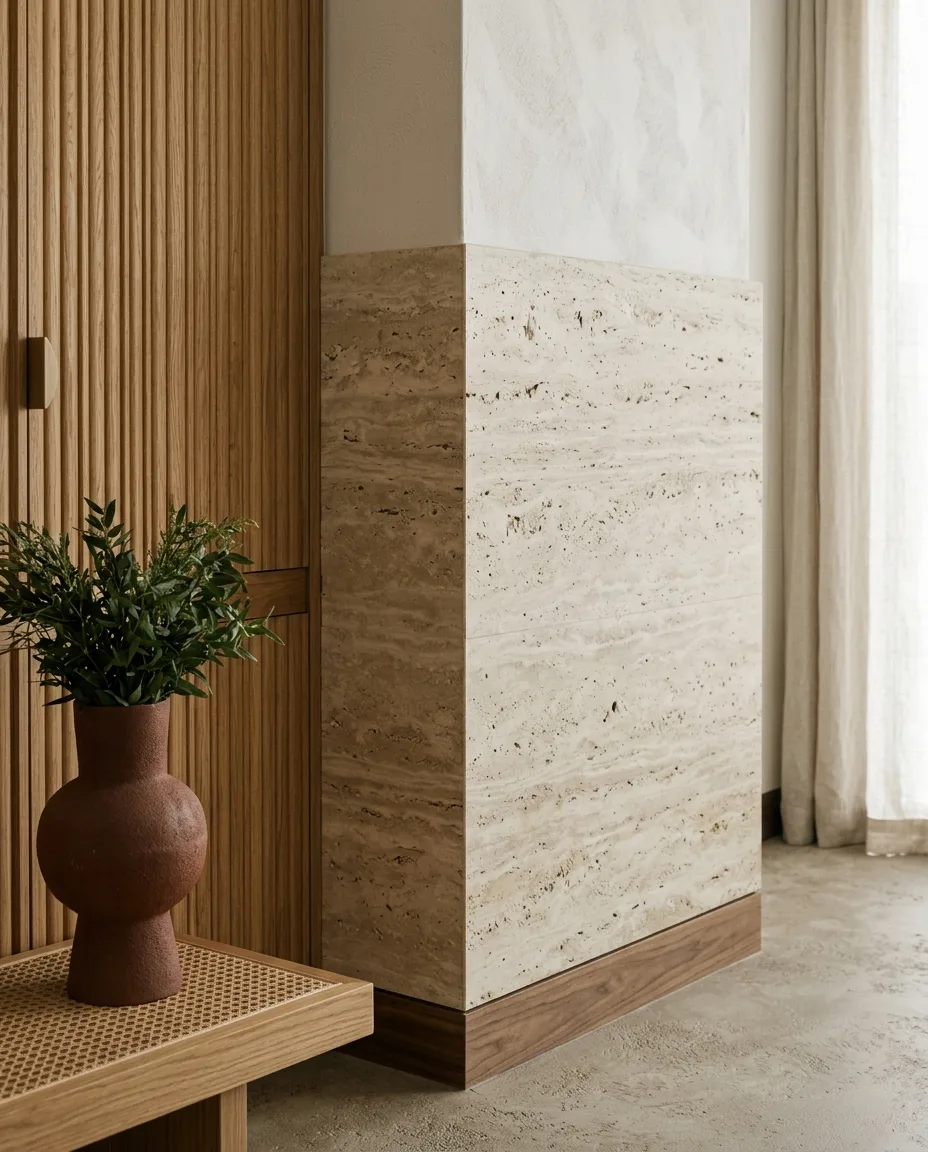
Without mitred edges. A cut edge reveals that the stone is only two centimetres thick. A mitred corner is three times the work; in return the figure carries around the corner and the cladding becomes solid stone.
How we detail it
- Grout width: 1.5 mm, with grout mixed to the tone of the stone. Light grout on a dark stone draws a grid of lines and takes away the sense of solidity.
- Edge detail: a mitre on an external corner, a 2 cm solid edge at a washstand, a bullnose edge on a stair.
- Impregnation: before installation and after it, then once a year. That is five minutes of work, and without it the stone will stain.
Frequently asked questions
What is the difference between travertine and marble?
Both are limestone, but travertine is a porous, layered sedimentary stone with warm beige-brown tones and a horizontal figure. Marble is denser, cooler and more dramatically veined. Travertine is more restrained — which is why it suits the quiet luxury approach better.
Can it be used with underfloor heating?
Yes; in fact stone conducts heat particularly well. Depending on its thickness it warms up a little more slowly, but after that it holds the temperature more evenly than a thin tile.
Is it suitable outdoors?
With a split or brushed finish, yes, but ask for a frost-resistant quality and expect that water settling in the pores will work on the stone over time.
How much more expensive is it than a stone-effect tile?
Typically two to three times. The difference does not show in a photograph, it shows in person: natural stone has depth, a printed figure does not. If the wall is the main character of the room, it is worth it. If it is background, perhaps not.
If this sounds familiar — that you want a material that will still be a good decision in ten years’ time — see how we work, or take a look at the Natural elegance project.
Next read: Microcement bathroom: when it is worth it — and when it is not