
Bouclé, linen, rattan: the textures that warm a minimalist space
Rattan furniture, bouclé armchairs and linen curtains through a designer’s eyes: what each texture does to a room, how to combine them, and where they wear.
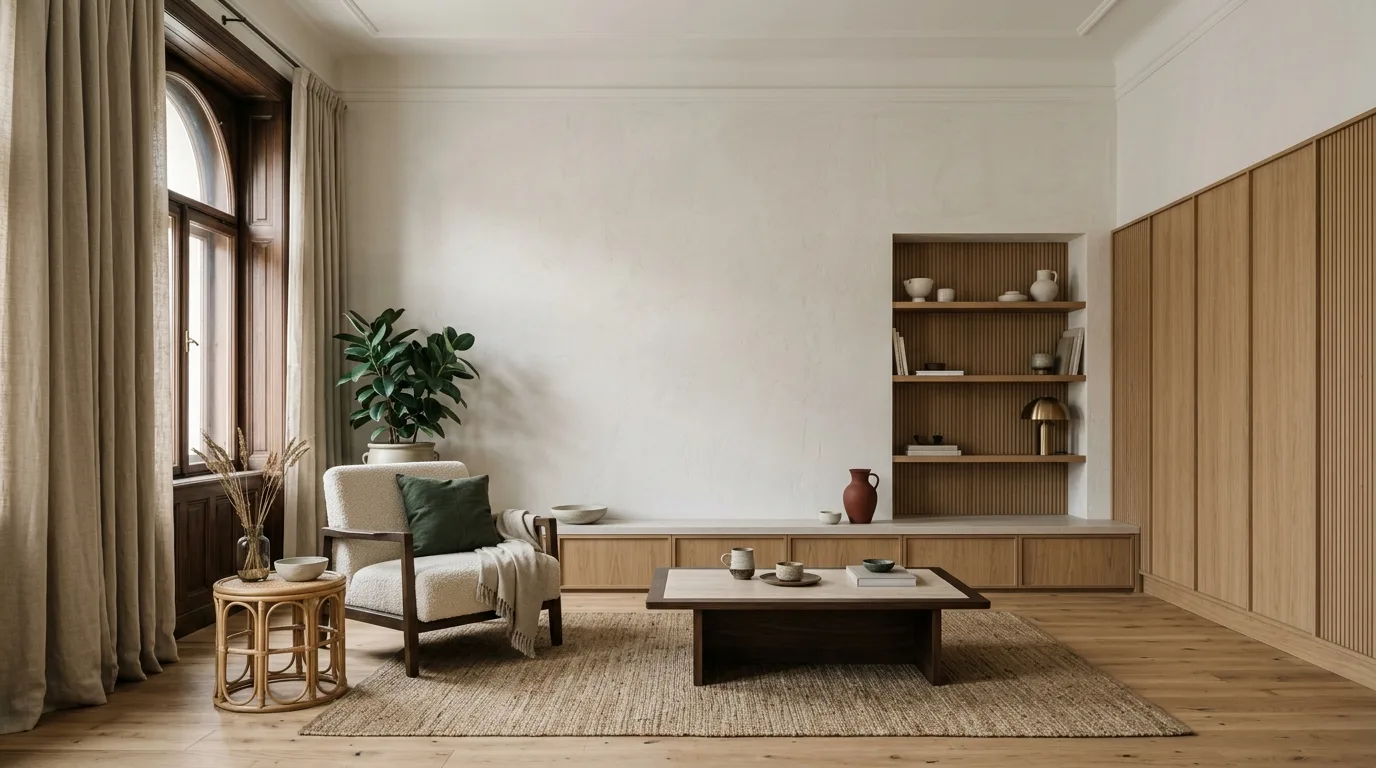
If a pared-back room feels cold, it is almost never the fault of the colours. What is missing is texture. The same off-white wall and the same oak floor behave quite differently if there is something beside them for the light to catch on.
At a glance
| What it solves | The cold, “empty gallery” feeling in pared-back rooms |
| The rule | At least three surfaces that feel different to the touch in one room |
| What ruins it | If all three are of the same scale |
| Where it wears | Bouclé with a cat, rattan in dry air, linen in the sun |
Bouclé: the surface that absorbs the light
The bouclé armchair became the emblem of warm minimalism because the looped fabric scatters the light — there is no glint on it and no sharp shadow. That turns it into a soft, cloud-like mass, and it is why it does not look large even when it is.
What to watch:
- Snagging. With a cat in the house, classic large-loop bouclé is ruined within a few months. There is a tighter-loop, “cat-friendly” version — ask for the upholstery code.
- Cleaning. The dust that settles between the loops can be vacuumed out, but stains are hard to get out. For pale bouclé, ask for a stain-repellent finish.
- One piece is enough. Two bouclé pieces in one room is already too much: the surface loses what makes it special.
Linen: the texture that moves
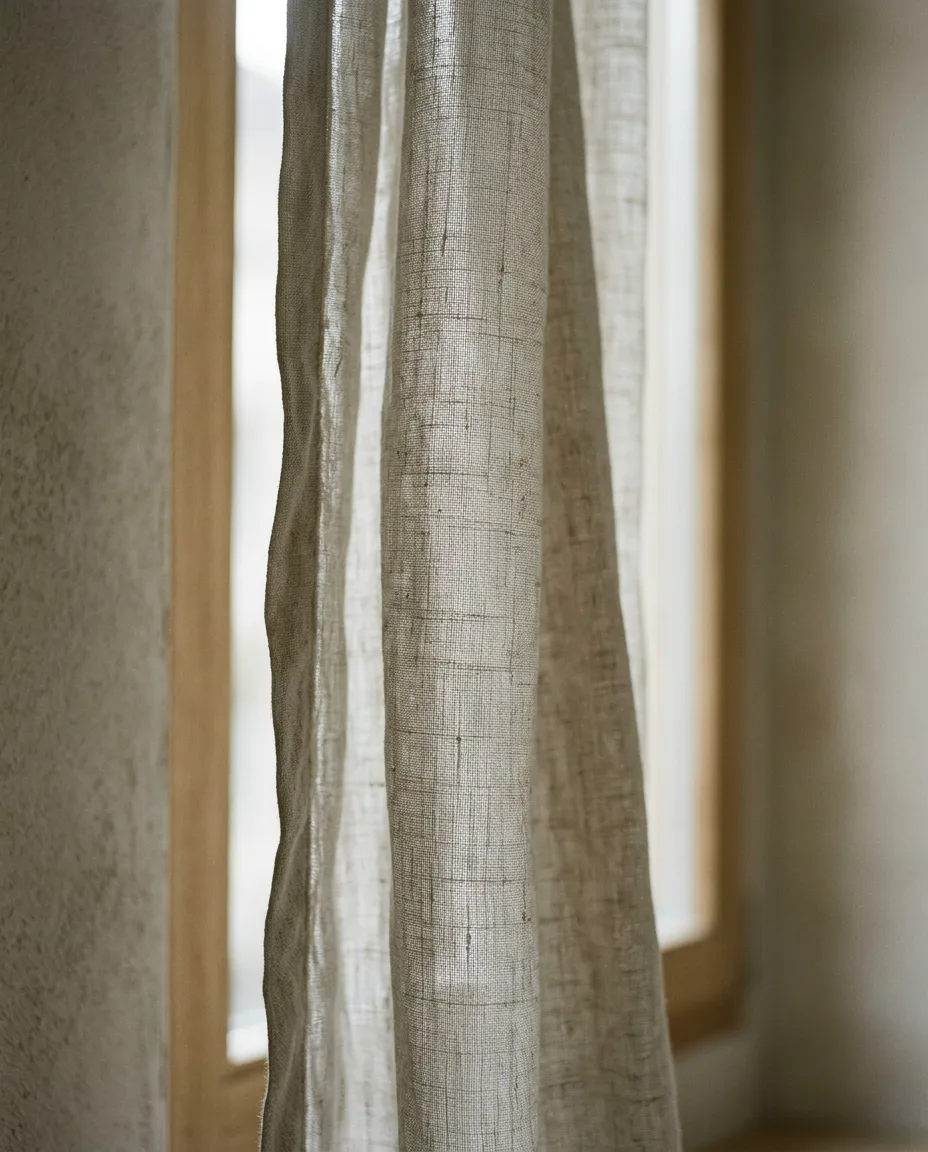
Linen curtains do not work through their pattern but through the fact that they fall irregularly. The creasing is not a fault — this is the one textile on which the crease is an asset.
Two practical points:
- Quantity. The width of the curtain should be 2–2.5 times the length of the track. Any less and it will have no folds, it will simply hang.
- Length. Either it reaches exactly to the floor (with a 1 cm gap), or it deliberately pools 3–5 cm on the floor. The “ankle-length” in between always looks like a mistake.
- Fading. At a south-facing window, natural linen lightens within 2–3 years. That does not bother many people — but it is worth knowing about.
Rattan and woven surfaces: the rhythm
Rattan furniture gives what a smooth surface cannot: a small, repeating rhythm. A woven cabinet-door panel or a rattan chair back is like a quiet pattern — you see it, but you do not have to decipher it.
Where it works well:
- As a cabinet door panel — on fitted furniture this is its best place, because it also ventilates.
- As the back of a dining chair — it makes the chair light, and beside a large table that counts for a lot.
- On small furniture: bedside table, side table, drinks trolley.
Where it does not:
- Close to the floor, where the mop reaches it.
- In very dry, heated air — natural rattan dries out and cracks. In a home with underfloor heating, choose a treated or synthetic rattan version.
The rule: three scales
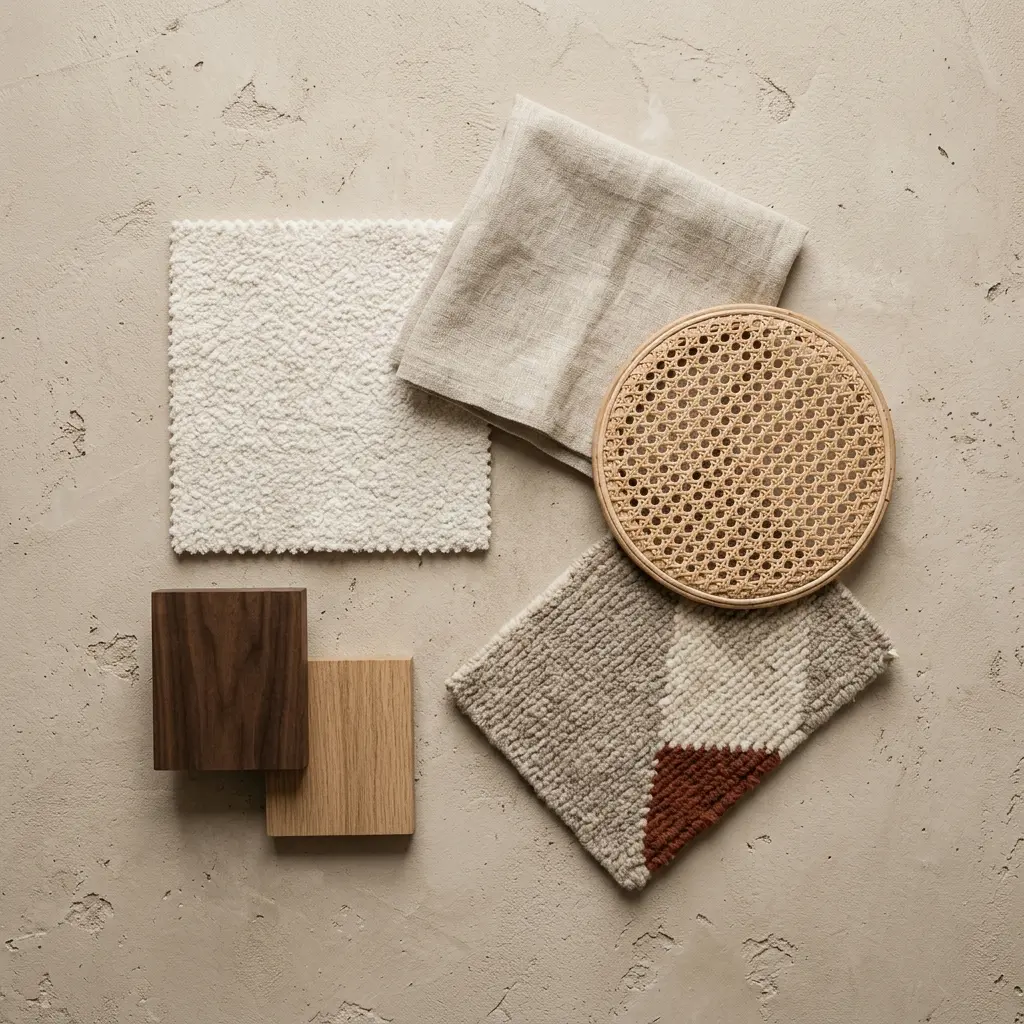
The most common mistake is not that there is too little texture, but that it is all of the same scale. If the rug, the cushion and the curtain are all of a medium-coarse weave, the eye finds no difference — and the room feels just as flat as if there were nothing in it at all.
What to aim for:
- One large, coarse surface — a ribbed wool rug, a bouclé sofa, slatted timber panelling.
- One medium — linen curtains, a woven panel, a knitted throw.
- One smooth and cool — stone, ceramic, glass, metal.
The third is the most important, and it is the one most often left out. Without a smooth, textureless surface the room does not become warm, it becomes woolly.
It works without colour too
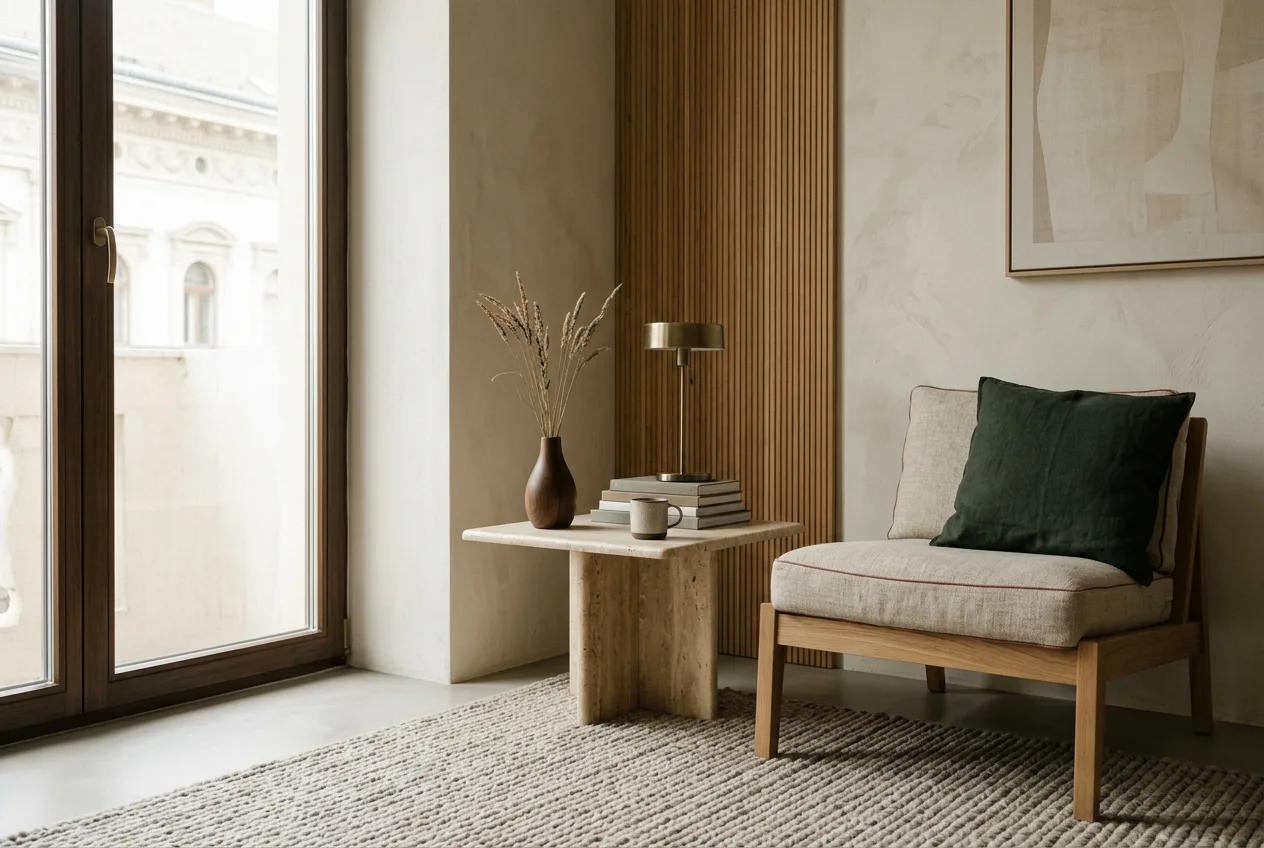
The best news in all of this: texture is not colour. Even in a completely monochrome, sand-toned room there can be five different surfaces — and that room will be richer than a colourful but smooth one.
This is the central trick of warm minimalism and of japandi: the variety comes not from the palette but from the touch. We have written separately about colour proportions as well.
Frequently asked questions
Does bouclé stand up to children and animals?
To children yes, to a cat not necessarily. Large-loop bouclé is vulnerable to claws. Ask for a tighter, short-loop upholstery, and ideally with a stain-repellent finish.
How much fabric does a linen curtain need?
2–2.5 times the length of the track, so that it has folds. For a 3-metre track that means 6–7.5 metres of fabric width. In length, either to the floor or pooling 3–5 cm on it.
Does rattan furniture cope with underfloor heating?
Natural rattan dries out in dry air and can crack. In a home with underfloor heating choose treated rattan, and keep the humidity between 40–50%. Natural rattan does not belong in a bathroom.
How many textures does a room need?
At least three, but the point is that they should be of different scales: one coarse, one medium and one smooth, cool surface. Five or six is fine too, as long as the palette stays unified.
If this feels familiar — that the flat is beautiful but somehow cold — see how we work.
Next read: Timber wall panelling and slats: why they make a room look larger